


Rule #1 of heating: it’s always the heat pump’s fault.
Often, it isn’t. It’s poor balancing.
When asked we all say that we balance the radiators. In reality, especially on heat pump systems, it’s rarely done well.
Some installers absolutely do balance properly. They also know how long that really takes.
Meanwhile forums are full of frustrated homeowners with some rooms that never get warm, and heat pumps that they think are terrible, but in many cases it’s down to poor balancing.
The thing is that doing it properly takes time, a lot of time. And a heat pump system running at dT5 is far less forgiving than a boiler at dT20, there’s already so little margin for error.
To make the point I’ll run through an example. Let’s say we have an 8 rad heat pump system. Let’s look at the first rad, it’s fairly chunky, specified correctly for the room. (Stelrad K3, 600 × 1.6 m, around 16 litres of water.)
This first room has a peak heat load of 1.28kW, and that makes this rad spot on at our flow temp of 45ºC, @ dT5. We picked this fairly low maximum flow temperature because this is a key part of low running costs = more happy customers = more referrals.
So far so good.
To hit that output at dT5 the radiator needs a flow rate of 3.76 l/min. Left unbalanced, it’s nowhere near that. The flow rate is far too high (11 l/min), output is too high (1.4 kW), and the dT is tiny (1.8º).
We balance using the traditional method - adjust the lockshield a bit and see if that’s helped. Feeling returns by hand simply doesn’t work. Skin isn’t sensitive enough, and the delay between radiators adds even more error when doing a whole system, and at dT5 that’s a non-starter.
Even with temperature clamps the sensors can be a degree out. At dT5, that’s a 20% error, which isn’t really ideal. So we swap to a thermal camera and make an adjustment.
We don’t know what the flow rate is because we’re effectively working blind - all we do it try our best to measure temperatures.
The real killer is time. Every adjustment needs the system to fully stabilise before you can trust the measurement.
It will take a time for the water to be fully replaced in the rad - more and more time as we reduce the flow rate towards what it needs to be. If it was well behaved then is would exchange in one neat pass - but in reality the water ends up mixing in the rad. Then it takes time for the metal of the rad to change temperature, for convection to establish, and for it all to finally settle into a new stable state.
At a conservative estimate that takes 15 minutes.
So that’s 15 minutes, or more, per adjustment - and then we can measure the temperature again. Everyone does that….. Right?
The output of the rad stabilised at 1.35 kW, with a dT across it of 3º (the flow rate is 6.3 l/min).
More adjustments are needed.
In the end it takes 3 adjustments to get the rad close to what we want.
The flow rate is 3.34 l/min - not that far off 3.76 - and the dT across it is 5.4º.
That took us 50 minutes.
There are 8 rads in total - which at 3 adjustments each is 6hrs 40 minutes.
We take half an hour for lunch, and the homeowner is one of the best ones - and brings us two cups of tea, and stops for a short chat. Add on 20mins.
During this process the house comes up to temp a couple of times, and so the heat pump switches off. We now have to wait for it to come back on again. Add on another 40 mins.
By the end of it, balancing one fairly normal 8-radiator heat pump system took over 8 hours.
- - - - -
And this is the reality.
In the vast majority of cases, we say we balance systems, but it simply isn’t happening properly. There’s not the time worked into the quote, and the customer would rarely want to pay for a whole day just for balancing if there was.
There is another way, a good option for many heating systems, but especially well suited to heat pump systems with modulating pumps.
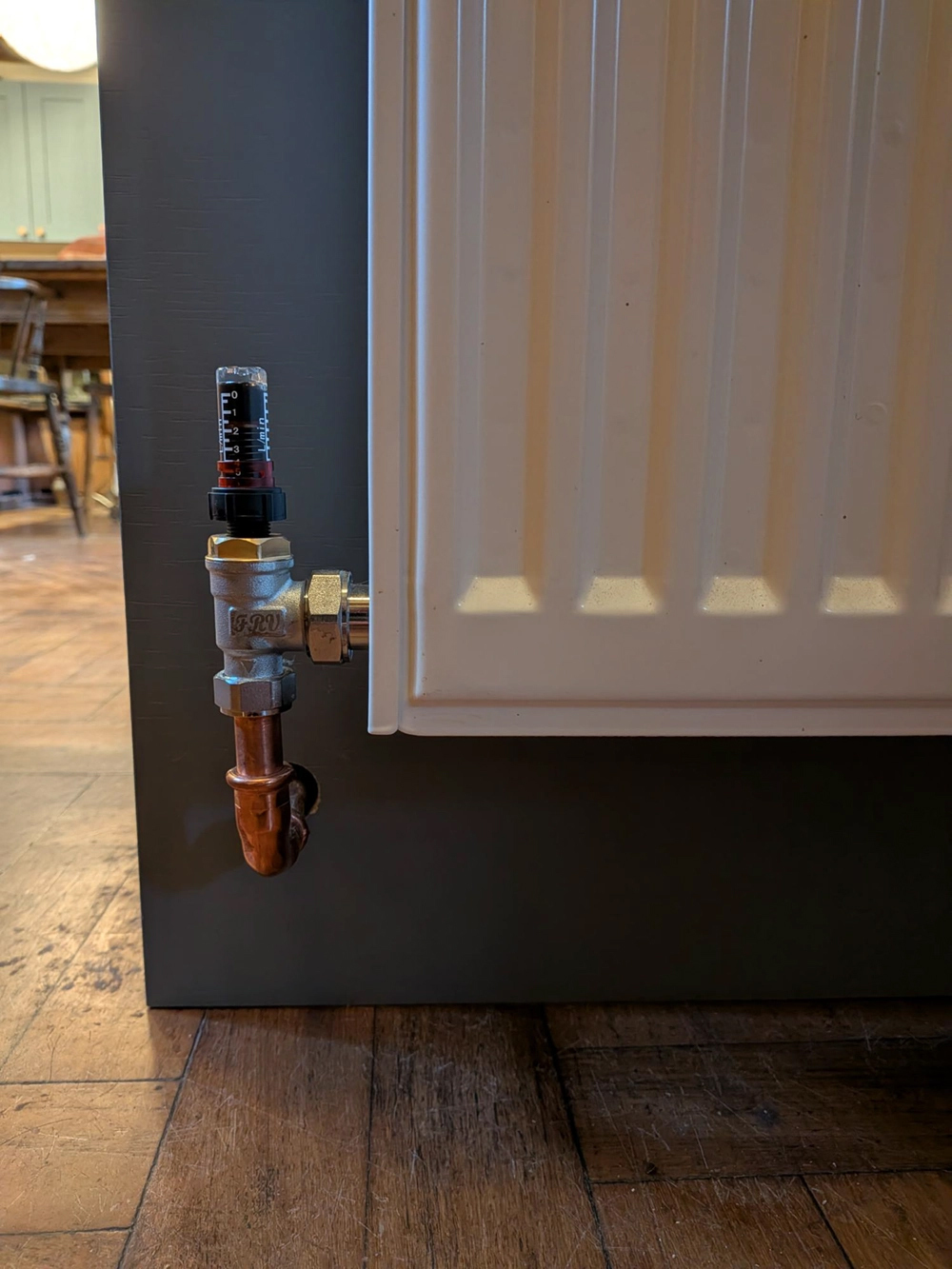
Flow Regulating Valves (FRVs) combine a lockshield with a built-in flow gauge, like you’re used to using already on underfloor manifolds. You can see the flow, set it accurately, and move on.
Instead of an all-day job, balancing typically takes around 15 minutes.
You can select FRVs from inside Heatpunk, as well as ordering online from Midsummer.
 Reset Cart
