


The Smartest System in the House
In November 2022 Graham Hendra posted a photo of his cat asleep on a radiator, and pointed out that of the two, the cat was the more sophisticated piece of engineering. She has a microchip that opens the cat flap; the radiator has no electronics at all.
"The boiler has no idea what room is cold, how cold, how quickly the room temperature is falling... It's pure 100% guess work."
Nearly four years later, he is still right. Almost every heat pump installed in Britain today runs on a distribution system with no sensors and no feedback.
The problem with open loop
The industry prescribes open loop for good reasons. With the TRVs out of the way, weather compensation can run the system continuously at the lowest flow temperature the building fabric will allow, which is how a heat pump should be run. But removing the TRVs also removes the only feedback the system ever had. In the best case, a single smart thermostat in a single room decides the flow temperature for the entire house, and everything else rests on a balance that was set once, at commissioning, with a lockshield and an infrared thermometer.
When that balance is wrong, the symptoms are predictable. One room stays cold while another overheats. The customer compensates by turning up the flow temperature, which costs them efficiency in every room at once. And in February the installer drives back across town to twist a lockshield a quarter of a turn. A source we trust estimates that around half of all callbacks in this industry come down to balancing.
What Adia does
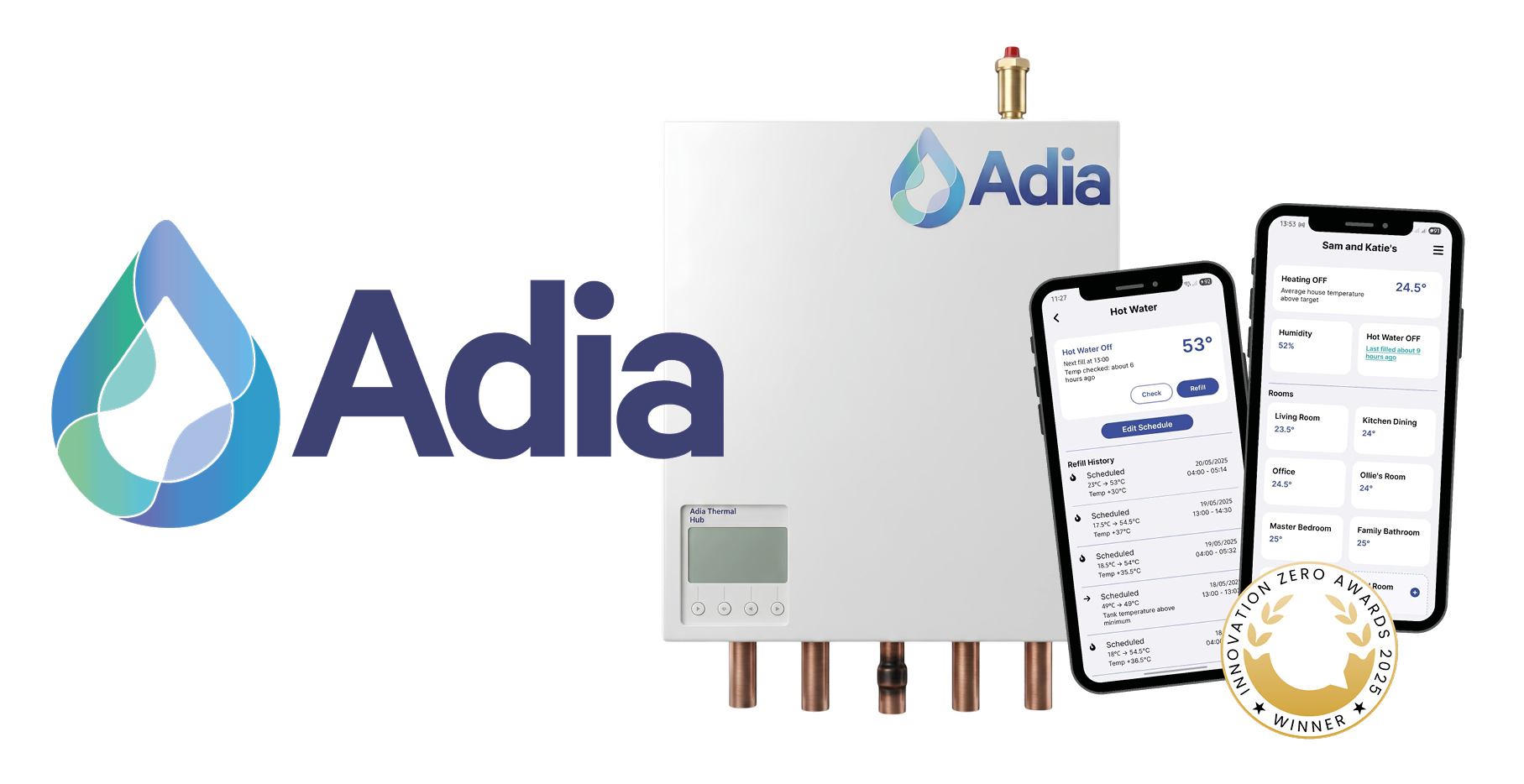
Adia is an operating layer that sits between the heat pump and the radiators a home already has. It consists of a pre-plumbed hub containing the hydraulic separation, a secondary pump and a hot water diverter; a flow balancing valve that screws onto each existing TRV valve body and runs below 20dB; and an ambient temperature sensor in each room.
Together these give the heating system something it has never had: measurement. Within three to four days, Adia has learned a house well enough to predict the temperature of any room 12 hours ahead to within 1°C. That model includes the heat loss of each room, the output each radiator actually delivers, and where the pipework restricts flow. The system distributes flow to each room continuously and keeps adjusting as conditions change, so an undersized radiator receives more water rather than the whole house receiving hotter water. Installation takes two to three days, with no pipework or radiator changes and minimal disruption.
That changes a few things on a job.
Radiator changes. Most of the 40 homes we measured through last winter kept every radiator they had, and still cut their bills. Where a radiator genuinely cannot deliver enough heat, the system identifies it from measured output, so replacement becomes an optional follow-up job rather than a condition of the quote.
Pipework. Existing pipework stays in place, including microbore in most cases. There is no lockshield balancing to do, and the index circuit no longer sets the terms for the whole house. If you suspect a restriction, you can test the flow to each radiator during commissioning, and a running system will tell you which leg is short and by how much.
Heat pump sizing. The heat loss calculation still governs the design, and more water has limits: a genuinely undersized emitter is still undersized. What changes is the margin. Open-loop flow temperatures carry an allowance for everything the design cannot see: balancing error, rooms getting less flow than the calculation assumed. Because Adia measures what each room needs and moves flow to match, it can hold the flow temperature at the lowest value the house will actually support. In an older property that may still be 55 or 60 degrees, where a modern heat pump delivers a COP of about 3, and tariff optimisation covers that case: the system heats the rooms and the hot water cylinder while electricity costs 7 to 14p, then coasts through the expensive hours. We call the result eCOP, the COP adjusted for what each unit of electricity actually cost. A COP of 3 bought at cheap rates outperforms a COP of 4 bought at peak; you can test the numbers at adiathermal.co.uk/tariff-calculator.
Comfort and bills. 95% of our customers report the same or lower bills with no radiators replaced, and an improvement in comfort.
Graham ended his post by asking emitter manufacturers to get in touch and build radiators that could talk back to the heat source. They have not done it yet. Adia does it with the radiators already on the wall, and Graham’s got an Adia in his house.
Adia is available through Midsummer.
 Reset Cart
